
Cities are key actors in driving climate action and while evidence shows major opportunities for health, many cities are failing to report on health co-benefits.
Cities play a vital role in the transition to a healthy, net-zero future. Over half the world’s population currently live in cities and the number is estimated to grow to around 70% by 2050. Although cities are a major source of greenhouse gas (GHG) emissions - accounting for around 70% globally - many are already leading the way in implementing climate solutions that can bring major near-term benefits to health.
A new analysis of city-level reporting of climate actions shows that while most cities report co-benefits related to climate mitigation actions (actions to reduce greenhouse gas emissions), many fail to report health co-benefits. Health co-benefits were reported for less than half (44%) of all reported actions with co-benefits, while economic benefits were reported for almost 70%.
The findings suggest a gap between potential and recognised health benefits, and highlight the need for greater awareness of the health co-benefits of climate mitigation among city-level policymakers to accelerate a healthy, net-zero transition.
The study, published in Nature Partner Journals (npj) Urban Sustainability, was led by researchers from the London School of Hygiene & Tropical Medicine as part of the Pathfinder Initiative.
The first analysis of its kind, this study uses data on the health co-benefits of climate mitigation actions reported by cities in response to the 2022 CDP-ICLEI Track questionnaire (published in 2023). The CDP-ICLEI Track is the world’s leading platform for annual climate reporting and progress for tracking for cities, led by CDP Cities, an initiative of CDP (formerly the Carbon Disclosure Project). The study addresses an important research gap to improve understanding of how and why cities report on health (and other) co-benefits of climate mitigation actions.
A total of 792 cities reported 5,040 GHG mitigation actions to CDP in 2022. The analysis included 584 cities and 3,835 reported actions, after missing data on sector and implementation status were removed.
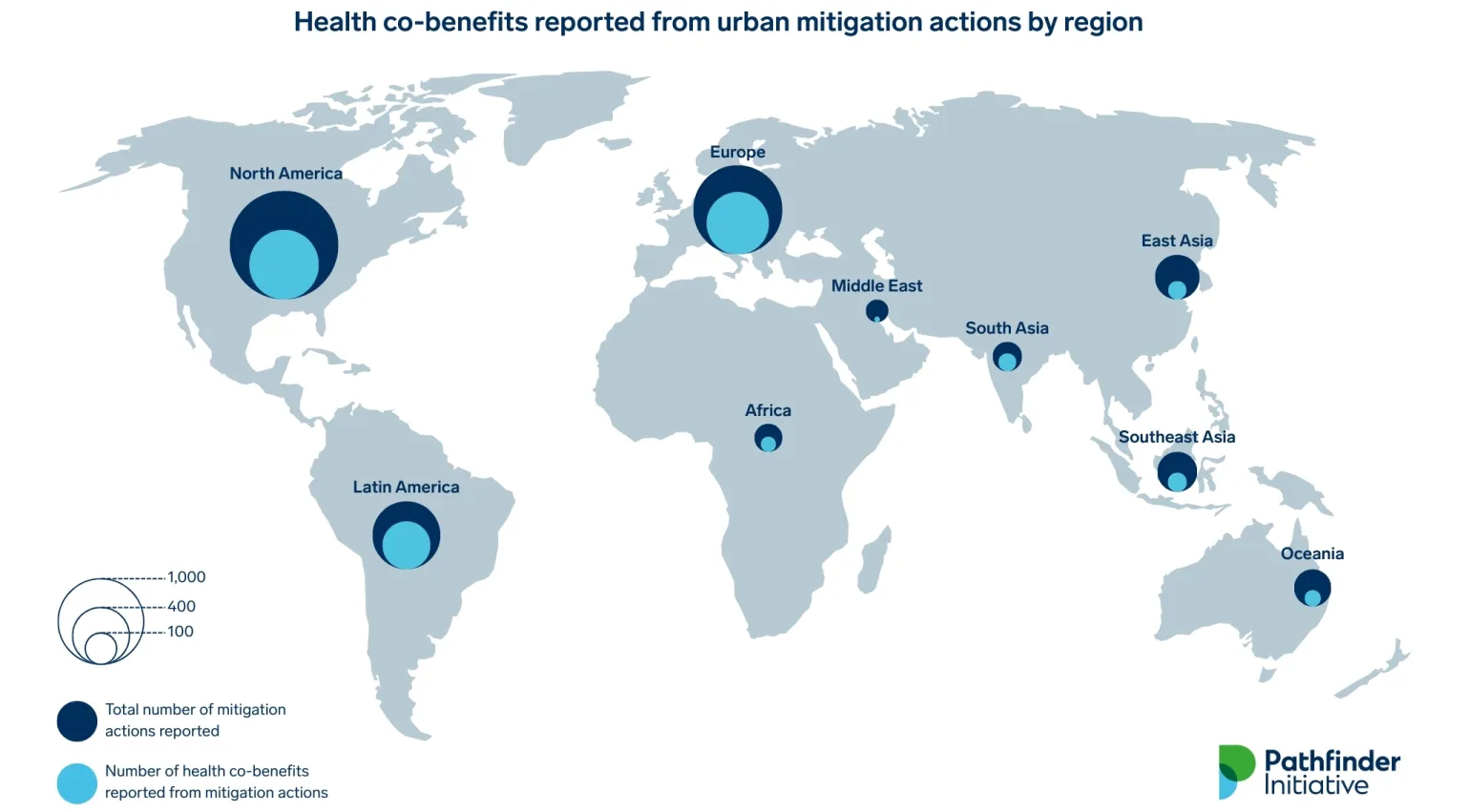
The greatest number of actions were from cities in North America (1,322 actions, 35% of total reported mitigation actions included in the analysis) and Europe (1,050, 27%). Much fewer actions were reported by cities in South Asia (79, 2%), Africa (73, 2%), and the Middle East (43, 1%).
By income level, according to country grouping developed by the Development Assistance Committee at the OECD from 2022, most actions were reported by high-income countries (2,776, 72%), with fewer actions reported by low- and middle-income countries (1,059, 28%).
Most actions were reported in the energy sector (1,661, 43%), followed by transportation (1,154, 30%) and waste (636, 17%), with relatively few actions reported in the Agriculture, Forestry, and Other Land Use sectors (AFOLU) (326, 9%) and industry (58, 2%).
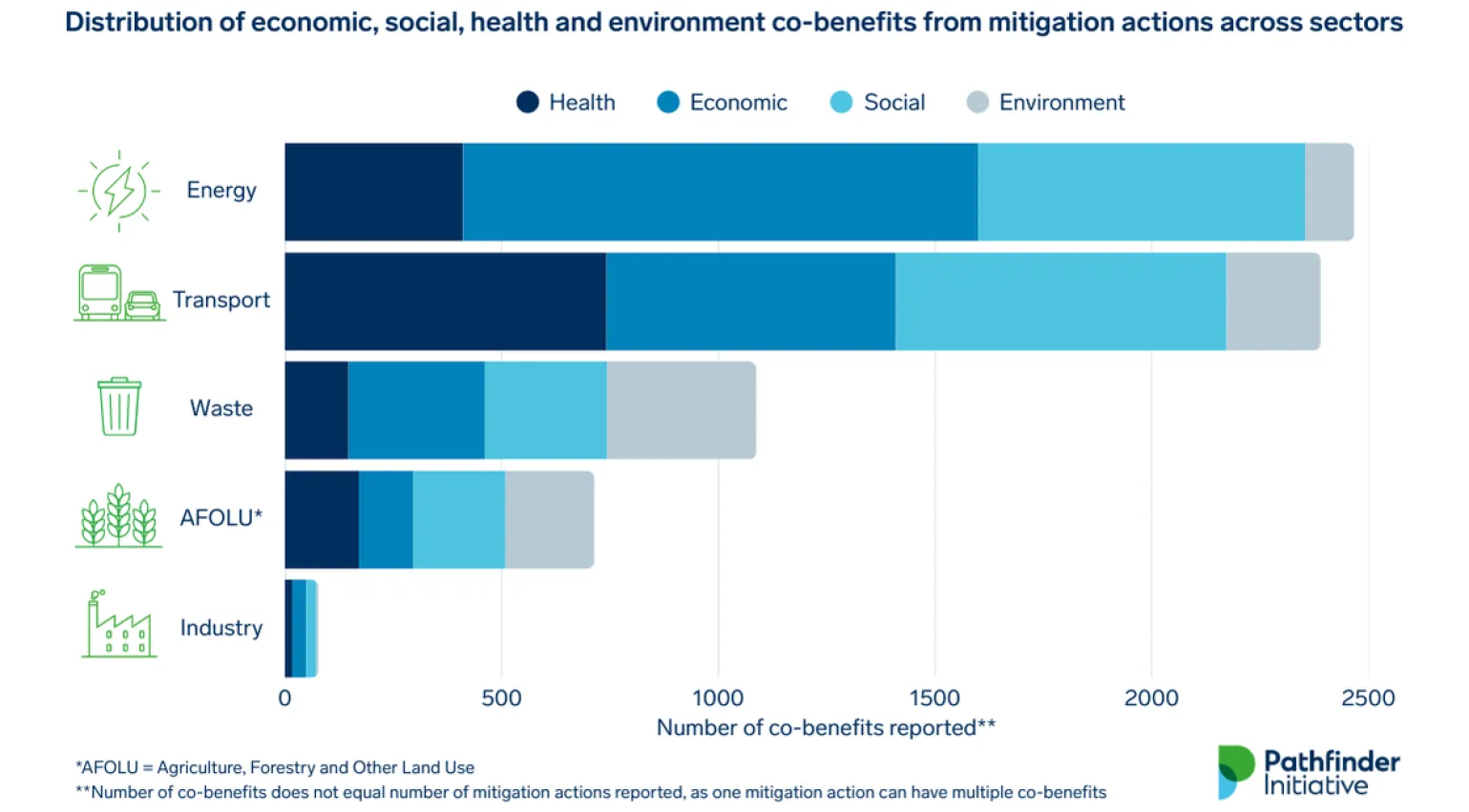
Co-benefits were reported for almost 90% of all actions. Despite this, the authors note that many cities failed to report or minimally reported any health co-benefits. Economic and social co-benefits were the most commonly reported co-benefits across all regions, except South Asia where social and health co-benefits were most reported.
Within the actions that reported health co-benefits (1,488 actions), a range of pathways and health outcomes were reported. These included improved air quality, improved mental wellbeing and quality of life, increased food security, reduced disaster or disease or contamination-related health impacts, and improved public health benefits. Improved air quality was by far the most reported health co-benefit across all sectors and in all regions was among the top two reported health co-benefits.
Economic and social co-benefits were most reported across sectors. Health co-benefits were reported second to social benefits in the transport sector, suggesting that the health benefits of transport interventions, such as increased physical activity and improved air quality, are better known than the health benefits of interventions in other sectors. Actions in the waste sector showed few reported health co-benefits despite the opportunity for sustainable waste management interventions to result in substantial health benefits through reduced air pollution.
The authors note limitations, including large amounts of missing data for the implementation status of the action and the sector, which meant some data had to be omitted from the analysis. They also highlighted the dominance of reported actions from North America and Europe, with much fewer actions from cities in Africa, South Asia and the Middle East, as well as limited inclusion of data from China and India. The authors also state that CDP data can be highly variable in part due to the wide range of individuals at different levels of seniority filling in the CDP questionnaire. This could result in a mismatch between implemented actions and reported data.
Blanca Anton, Research Fellow at LSHTM and lead author of the study said: “Cities are driving innovative climate action, but also face competing priorities that create barriers to implementation. Communicating and capitalising on the near-term health co-benefits of climate action can help align climate policies with other developmental goals, while increasing public support.”
“Our findings suggest that cities are not sufficiently recognising the health co-benefits of mitigation actions. Improving awareness and reporting of the health benefits of climate action would strengthen the role of cities in achieving climate goals.”
Publication:
Anton, B, et al. Pathways to health: Reporting on health co-benefits from urban climate mitigation action varies by sector. npj Urban Sustain . https://doi.org/10.1038/s42949-025-00311-y