
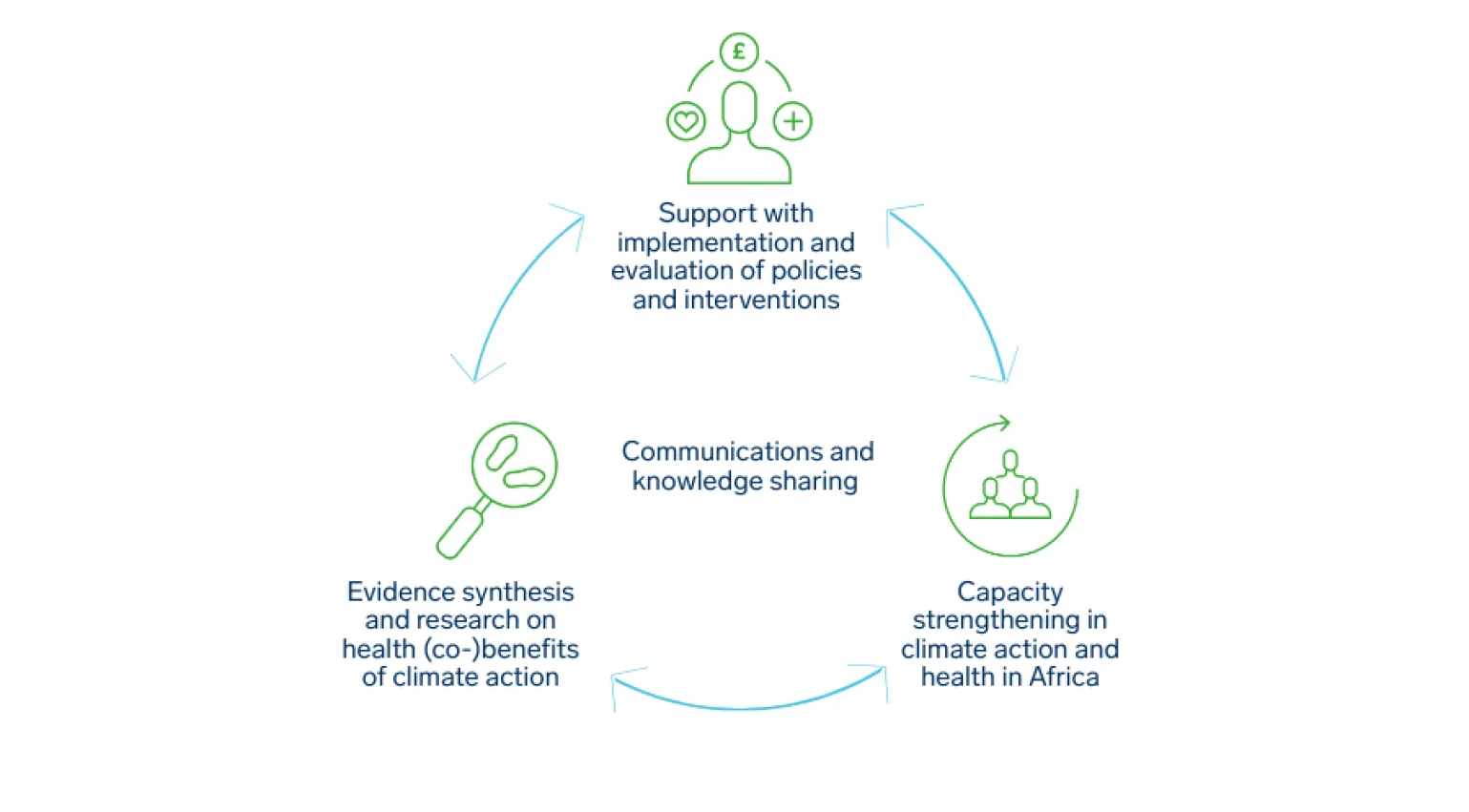
The Pathfinder Initiative research programme aims to strengthen the evidence base for action on climate and health, support with the design, implementation and evaluation of policies and actions, and facilitate knowledge sharing.
The Pathfinder Initiative research programme
As part of the first phase of the Pathfinder Initiative, researchers at the London School of Hygiene & Tropical Medicine (LSHTM) with oversight of the Lancet Pathfinder Commission, carried out an umbrella review (review of reviews) on the health benefits of climate mitigation actions across sectors. The review highlighted the potential for major health benefits, primarily through three key pathways: cleaner air from fossil fuel phase out and a transition to clean, renewable energy; shifting to healthier, more sustainable diets; and increased physical activity through the promotion of active travel (walking and cycling) alongside public transport.
The review also highlighted gaps in the evidence, and challenges in bringing together data from studies that use diverse methods and metrics. In addition, the research showed that the majority of evidence comes from modelling studies (showing potential benefits), with only limited evidence on the climate and health impacts of implemented solutions. The Pathfinder Initiative Climate & Health Evidence Bank showcases solutions with quantified greenhouse gas emissions reductions and health benefits, but more evaluated examples are needed to inform and inspire further action.
Read the Pathfinder Commission report
Watch a video about the Pathfinder Initiative
The second phase of the Pathfinder Initiative aims to address these evidence gaps and accelerate the implementation and evaluation of policies and actions for climate and health, with a focus on three key areas.
Strengthening the evidence base for action
The Lancet Pathfinder Commission report on pathways to a healthy, net-zero future provides the most comprehensive overview to date of research on the health benefits of climate mitigation actions. Research currently underway builds on the findings of the report, and aims to continue to strengthen the evidence base for action.
The Pathfinder Initiative research team is carrying out further reviews to bring together existing evidence on the health benefits of climate action, including a recent review led by LSHTM researchers on the health and wellbeing impacts of tree-based interventions in low- and middle-income rural settings and a review of public health co-benefits of strategies consistent with net-zero emissions.
To encourage best practice in research and harmonise the evidence base, we are working to develop guidelines for studies modelling climate mitigation actions and the health co-benefits. The Guidance for Health Effects of Mitigation Modelling Studies (GHEMMS) checklist is currently under review and will be made available soon to inform to the design, conduct, and reporting of modelling studies.
We are also finding innovative ways to synthesise evidence. Research teams at the Potsdam Institute for Climate Impact Research (PIK) and LSHTM are working on the creation of a machine-learning assisted global living evidence map that rapidly brings together data on climate and health, and will provide an important resource for researchers and evidence users.
As part of the Pathfinder Initiative, researchers from the University of Wisconsin-Madison’s Climate Solutions for Health Lab are also analysing the health and equity impacts of climate and clean energy incentives in the US, with a particular focus on the Inflation Reduction Act.
Guiding implementation and evaluation of climate and health actions
As well as advancing evidence synthesis, partners of the Pathfinder Initiative including LSHTM, C40 Cities, CDP, the Organisation for Economic Cooperation and Development (OECD), the Sustainable Development Solutions Network (SDSN), and the Hot or Cool Institute are working with cities to support the implementation and evaluation of solutions for climate and health.
Ongoing work includes engaging with city-level decision makers to support incorporating health into climate action, planning, and monitoring and evaluation frameworks. The work will result in co-designed policy recommendations for integrated urban climate and health strategies, and high impact case studies showcasing examples of cities around the world that are already taking action to accelerate a healthy, net-zero transition.
In addition to producing guidelines for modelling studies, we are working to develop guidance for the evaluation of implemented actions. A recent publication in The BMJ provides a practical checklist, adapted from the Medical Research Council guidance for public health and informed by research findings from the Pathfinder Initiative, to support the design and evaluation of complex climate and health interventions using a planetary health perspective.
Knowledge sharing and capacity strengthening on climate and health in Africa
Climate risks such as extreme heat, floods, drought, and food and water insecurity affect Africa disproportionately, while unsustainable practices such as fossil fuel use, poor waste management, and deforestation amplify the disease risks, undernutrition, and poverty. At the same time, there are major opportunities for Africa to adopt low-carbon, climate-resilient, and health-promoting pathways.
This workstream, led by the African Institute for Development Policy (AFIDEP), the African Population and Health Research Center (APHRC), and LSHTM aims to accelerate climate action for health in Africa and facilitate knowledge sharing among researchers, policymakers, civil society and other key actors working at the climate-health intersection.
APHRC is currently leading an analysis of health in Kenya’s climate change policies, and will provide policy recommendations for more integrated strategies. Workshops led by AFIDEP and LSHTM have also highlighted key challenges and opportunities for climate and health research, policy and action. A recent report produced by research teams at AFIDEP and LSHTM on ‘Framing of health co-benefits of climate change mitigation in Africa’ highlights the need for greater emphasis on win-win solutions for climate and health in Africa, and outlines practical pathways to a healthy, low-carbon future in the African context.
At the Second Africa Climate Summit in Ethiopia, AFIDEP and LSHTM launched a new Community of Practice on Climate Action and Health in Africa to share knowledge, foster interdisciplinary collaboration and cross-sectoral partnerships, and support the uptake of evidence-based policies and programmes that deliver both climate and health gains.
Further resources will be made available soon on the Climate & Health Evidence Bank.
To keep up to date, sign up to the Pathfinder Initiative newsletter.