
Experts from the Global Climate and Health Alliance and Pathfinder Initiative urge governments to show climate and health ambition in their national climate plans.
As leaders gather for COP30, Fabio Cresto Aleina and Jess Beagley from the Global Climate and Health Alliance and Andy Haines, Co-Chair of the Pathfinder Initiative and Professor of Environmental Change and Public Health at the London School of Hygiene & Tropical Medicine, warn that without immediate, transformative global action to reduce greenhouse gas emissions, worsening health risks will rapidly exceed the limits of adaptation in many settings.
In a comment piece published in the BMJ, the authors emphasise that ambitious climate mitigation and adaptation action across all sectors would not only avert the worst health impacts of climate change, but also bring additional health gains through clean air, safe water, nutritious food, and safe active travel.
In 2025, governments could show climate and health ambitions through submitting Nationally Determined Contributions (NDCs) – the third iteration of their national climate plans, which detail targets for reducing emissions by 2035. So far, 98 countries, responsible for 72.7% of global emissions have submitted new NDCs.
Analysis of previous NDCs by the World Health Organization found that 91% make some reference to health and 63% have health adaptation actions, but only around 30% identify the health benefits of reducing emissions or allocate finance for climate-health action.
The authors note that while some countries acknowledge health in climate planning, most stop short of including measurable targets, financing, or intersectoral coordination mechanisms. They recommend that health should be reflected in NDCs through the following actions: align emission reductions with the Paris Agreement, including targets for non-CO2 emissions; take action in the healthcare sector; optimise health gains across sectors; and ensure support for implementation and monitoring.
The piece emphasises that achieving these actions will require cross-sectoral coordination including between ministries of climate, energy, transport, agriculture, health, housing, and finance, alongside consultations with local and indigenous communities and civil society.
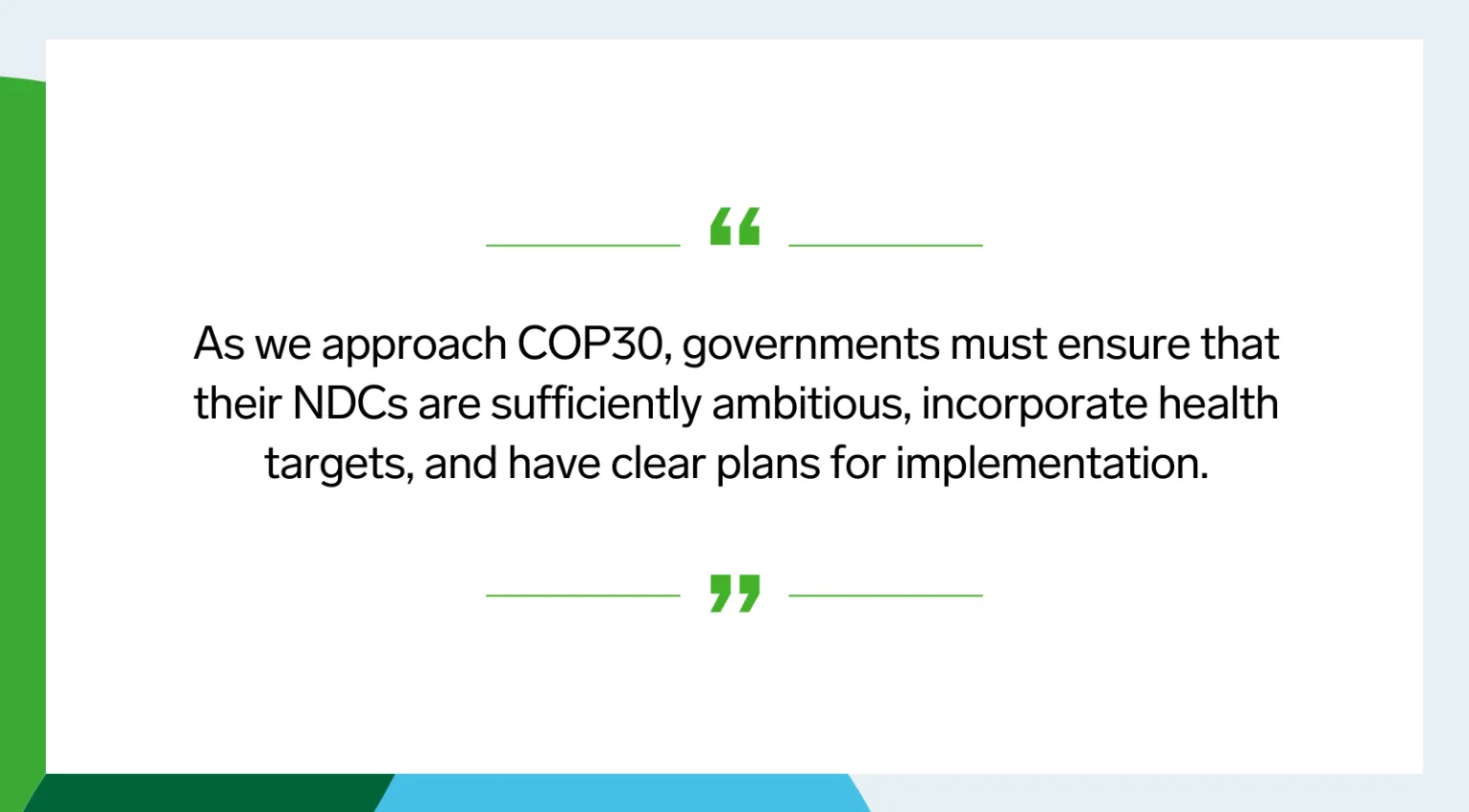
The authors conclude: “As we approach COP30, governments must ensure that their NDCs are sufficiently ambitious, incorporate health targets, and have clear plans for implementation. In 2026 and beyond, the health community should seek opportunities to engage with governments to maximise the potential health gains of NDC implementation.”
Read the full comment in the BMJ .
Publication
Beagley, J. et al. Governments should show climate and health ambition in their nationally determined contributions. BMJ. https://doi.org/10.1136/bmj.r2217